
Table of Contents
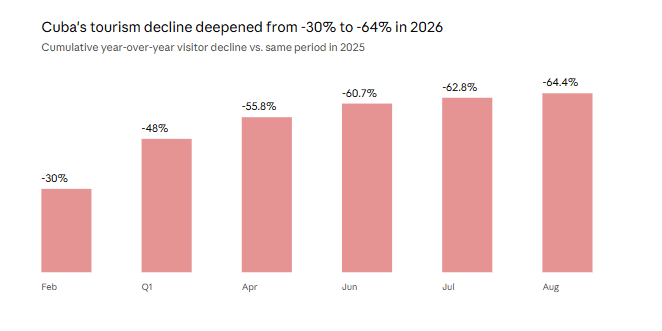
the Cuba tourism 2026 numbers are stark: an industry that was once one of the island’s largest sources of foreign currency is in freefall. By August 2026, international arrivals were down 64.4% year-over-year, the worst collapse in decades, according to Cuba’s own statistics office. This isn’t a story about changing travel trends. It’s a direct consequence of a geopolitical chain reaction that started thousands of miles away, in Venezuela.
By the Numbers
This isn’t a gradual slowdown — it’s an accelerating collapse. Cuba’s cumulative year-over-year visitor decline widened every single month through 2026, according to official data from ONEI:
By August, Cuba had received just 450,353 international visitors for the year — down from about 1.26 million over the same period in 2025. Canada, historically Cuba’s largest source market, saw arrivals fall by more than 75% by August, while reported first-quarter hotel occupancy was only about 13% to 21%, depending on the source.
The Root Cause: A Chain Reaction From Venezuela
The collapse traces back to January 3, 2026, when a US military operation removed Nicolás Maduro from power in Venezuela. Cuba had long relied on discounted Venezuelan oil to keep its lights on and its economy functioning — without it, the island has struggled to keep electricity running and to maintain food and medicine supplies.
The Hotel Exodus
The collapse deepened in May and June 2026, when the US Treasury Department’s Office of Foreign Assets Control set a June 5 deadline for foreign companies to sever ties with GAESA, the Cuban military-controlled conglomerate that dominates the island’s tourism infrastructure.
Within days, four major international hotel operators exited or scaled back:
- Blue Diamond Resorts (Canadian) ceased operations entirely, transferring control of its 62 properties — over 12,900 rooms — to the Cuban state’s Gaviota Tourism Group
- Iberostar Group (Spanish) stopped operating 12 of its 18 hotels from June 1 and later halted the remaining six, according to reports
- Meliá Hotels International confirmed the closure of its 34 Cuban establishments on July 21
- Archipelago International severed its property management ties with Gaviota
By late July, the Cuban government itself acknowledged that seven international hotel chains had stopped operating on the island. Blue Diamond’s own statement cited “reduced and suspended flights to Cuba,” fuel and electricity shortages, and “deterioration of hotel operating conditions” as reasons for its exit — notably, alongside the sanctions pressure itself.
Compounding Friction for the Travelers Who Do Show Up
Even visitors willing to make the trip now face a harder experience:
- About 73% of Cuba’s hotel facilities were closed in late July, according to the prime minister
- Reported hotel occupancy in the first quarter ranged from about 13% to 21%, depending on the source
- International travelers report new difficulties using Visa and Mastercard on the island, complicating an economy already reliant on cash and informal currency exchange
- Around 25,000 hotel workers were reported idle or on standby as of late July
Each of these compounds the others: fewer working hotels and harder payments mean a worse experience for the visitors who do arrive, which in turn makes word-of-mouth and repeat travel even less likely.
No Market Is Escaping the Decline
Cuba’s statistics office says the drop hit every source market. Canada, historically the biggest by far, fell from 526,239 visitors in the first eight months of 2025 to 128,400 in 2026. Visitors from the United States fell by about half, and Russia, Spain, Colombia, Argentina, Mexico, and China all dropped sharply too.
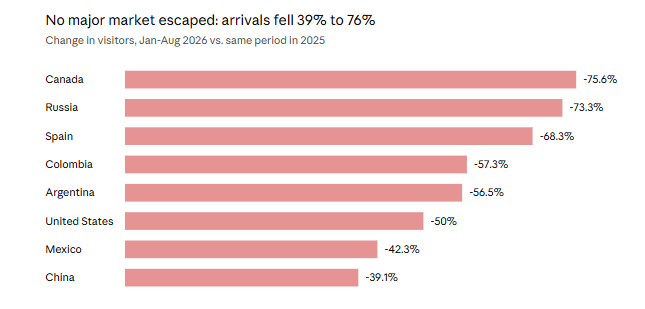
That matters because it rules out a simple “visitors are switching to other markets” story. Cuba isn’t replacing lost Canadian demand with demand from elsewhere.
Official messaging has been mixed. On July 29, the prime minister told the National Assembly that 73% of hotel facilities were closed and described the sector as in almost total paralysis. Around the same time, a government tourism adviser said the island’s hotels remain open and the destination operates normally. Havana has also announced private-sector reforms and says it is opening up, but so far there is no sign of a recovery in the data.
The Longer Decline Behind the 2026 Crash
Cuba’s record year was 2018, when it welcomed about 4.71 million international visitors. After the pandemic, arrivals recovered to roughly 2.44 million in 2023, then slid to about 2.20 million in 2024 and about 1.81 million in 2025. That is already around 62% below the 2018 peak before 2026 began.
So the 2026 collapse isn’t a bolt from the blue. It is a sharp acceleration of a decline that was already underway, triggered by fuel, flights, and sanctions pressure landing on a tourism sector with little resilience left. By August, Cuba had received 450,353 visitors, less than a tenth of the 2018 annual total.
What This Means If You’re Thinking of Visiting Cuba
The reports describe a destination where plans can fall apart for reasons outside your control. Before you book, consider the following:
- Check your government’s travel advice first. One travel guide reports that Canada and the UK both advise against non-essential travel to Cuba. Look up your own country’s current advisory, because it can also affect your travel insurance.
- Confirm your hotel is actually open. About 73% of hotel facilities were reported closed in late July, and the same guide reports at least eight hotels in Varadero and the northern cays closed because they had no diesel for generators.
- Expect blackouts. Resorts run generators, but guests have reported them failing during nationwide outages.
- Check flights directly with the airline. Many airlines suspended Cuba routes in 2026, and the guide reports that some resort islands have no scheduled international flights.
- Plan for cash. The guide says card payments haven’t worked since June, so you may need to carry all your spending money.
- Book flexibly. Choose refundable or changeable bookings, and have a backup plan if a flight or hotel is cancelled.
The travel-guide claims come from a single commercial source, so confirm them with official advisories and your airline before you act.
The Bottom Line
Cuba’s tourism collapse isn’t a story about changing tastes. It is a chain reaction: a change of power in Venezuela and a US oil blockade cut off the island’s fuel, shortages grounded flights and darkened the grid, sanctions pushed foreign hotel operators out, and a tourism sector already far below its peak had nothing left to absorb the shock.
Recovery depends mostly on factors outside the tourism industry’s control, such as fuel supply, sanctions, and the state of the power grid. Until those change, little in the data suggests a rebound.